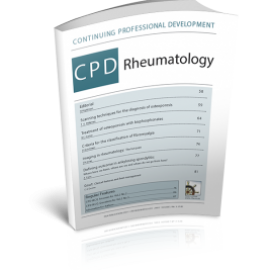
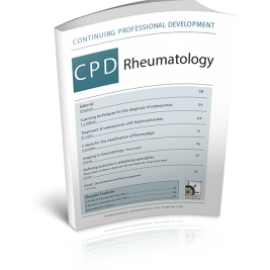
Description
This issue of CPD Rheumatology revolves around conditions encountered day-to-day in many rheumatology clinics: back pain, Paget’s disease and osteoarthritis. In common with almost all rheumatic conditions these are chronic, the aetiologies are not known, treatment is often empirical and these areas tend to be neglected today, as we are prone to concentrate on the more “exciting” inflammatory disease. The latter occurs at our and especially our patients’ peril! In addition to rheumatologists, these diseases are also of particular relevance in primary care where the main burden of these diseases are borne.
In the second of a series of three related articles, Stewart Donald explores how to apply appropriate rehabilitation principles to acute and chronic back pain, focusing on psychosocial factors and highlighting the importance of suitable triage to such patients – which in, some centres, is being performed very successfully by paramedical staff.
Paget’s disease is discussed by Bill Fraser – who has one of the largest populations of such patients in the world. In addition to describing the varied clinical picture of this condition, often missed, and evaluating the increasing options for treatment, he addresses the difficult issue of how and when to treat asymptomatic patients.
Sheila O’Reilly tackles the tricky problem of critically summarising the evidence (sometimes disturbingly lacking) behind the various forms of therapy used for osteoarthritis. The critical evaluation of therapy, with a focus on non-pharmacological intervention, is particularly important in planning and defending the use of medical and multidisciplinary paramedical staff in the management of such chronic rheumatic conditions.
Ankylosing spondylitis (AS) is an important cause of back pain that we often see at a relatively late stage – where it is easy to diagnose. However, it is very important to diagnose this early, not least because of the encouraging results from anti TNFa therapy in this condition. It might therefore be surprising to learn that current internationally accepted guidelines for diagnosing this condition do not take into account the rapid advances in imaging – able to detect disease at an early stage. This problem is addressed by Bijoya Rowchowdhary in an interesting article discussing the diagnostic criteria for AS.
Finally, this is the last issue of CPD Rheumatology that I will edit. I am standing down, to focus on the many other activities I am involved in. I have enjoyed the challenge of starting up this new CPD Journal. I would particularly like to thank the editorial board for their support and contribution, and the many reviewers who have ensured that all articles have been critically peer reviewed to maintain such a high quality. I would especially like to thank the contributors, for writing such stimulating and practical papers. I wish Neil Hopkinson success in his role as the new editor.
Editor