Description
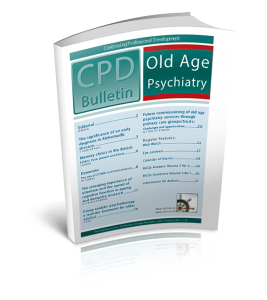
This edition of the journal has come round very quickly; it does not seem so long since the last one. I thank all those for the positive feedback we have received – I am glad some people seemed to enjoy reading it as much as we did preparing it. This edition contains several papers on the theme of early diagnosis in dementia, including the assessment of it and why it is necessary. It also has several papers that were sent in directly; which are perhaps the more important, as it is this engagement we wish to encourage. The early dementia theme was chosen to highlight the leap we now have to make from treating mainly moderate to severe dementia (up to 75% of our work, according to our centre’s recent survey); towards mild to moderate disease being the core focus. This is clearly the need, now we have licensed treatments for this stage of the illness in AD.
It is clear from the National Service Framework that new resources will be limited, and to use NICE money on too much structure will deprive the patients of the drugs they need, perhaps perpetuating the lottery further. The main place we will derive new resource from is disinvestment from old ways and a re-evaluation of what our core business actually is. I find that everybody working around us has a preconceived (almost delusional) belief about what we do and don’t do and particularly what we should do – much of which is at least 10 years out of date. While we have developed community methods and acquired new drugs, our specialist skills have improved and the trainees seem to have found the benefits of working in our field and opt more and more to train with us. General psychiatry continues to defend the 65 year barrier between services, even though it discriminates against choice, age and sensible patient care; while geriatric medicine in some areas has been replaced with “physicians with an interest (partial!) in the elderly”. This leaves us to blame for everything that does not work in elderly care, especially when those with dementia unfortunate enough to end up in a bed in an acute hospital stay too long. It is time that we produced a core directory of what we could and should offer to make it clear to those around us we are not the “take-away” service that it is still conceived we ought to be. If anyone has thoughts on such a directory could they be e-mailed to me at the research centre. This would be greatly appreciated, as I feel it an important part of the CPD agenda and would happily create space in the journal.
The next political landmark we face is the commencement of free nursing care along with the introduction of care homes from October 1st. Although this is creeping nearer with little or no fanfare, it may have quite an effect on our services, perhaps detrimentally, but also maybe, open up some opportunity to develop new partnerships with the private sector. They have new buildings and few qualified staff, for which they compete with us. We have in many instances old buildings and high vacancy factors. Creative combinations must be achievable in this scenario. If you are involved with a good example of partnership care, existing or planned, let us know, citing what is innovative and successful about it; as again I think this is a good way of to help foster new thinking and development – essential components of CPD.
The journal is designed to be iterative, and needs contribution and feedback to function properly. CPD is about maintaining the appropriate skills to perform the job in hand, and to this extent revalidation is the current vogue. We will be designing our own learning portfolios and partnering with colleagues to share learning and development. Mentoring has been discussed for new consultants, but I am not sure that what I have seen to date actually reflects a true mentoring process and needs more work. This is all a bit new, especially to us consultants, who have functioned a bit in autonomous isolation, and some may find getting going a little strange at first. Once again, if anyone has come up with creative schemes that have proved effective I would love to have examples to publish, so that others can learn.
Over the next few years both old age psychiatry and the medical profession will be undergoing a lot of change. Most of this will hopefully be for the better, and, as with all change, will be done at different pace for different things by different people. I would like to see the journal used to help facilitate some of this change, and disseminate good examples of development to everybody. For all of the above, articles of 1000 to 1500 words, with an abstract, a few key words and references would be really appreciated. I would also like key papers or web sites sent in for feature in those parts of the journal. I do not want this to be a freebie that sits in the great round filing cabinet unread. We all have stories to share and tell. Remember:
“What do we live for if not to make life less difficult for each other” – George Elliot.
R Bullock